
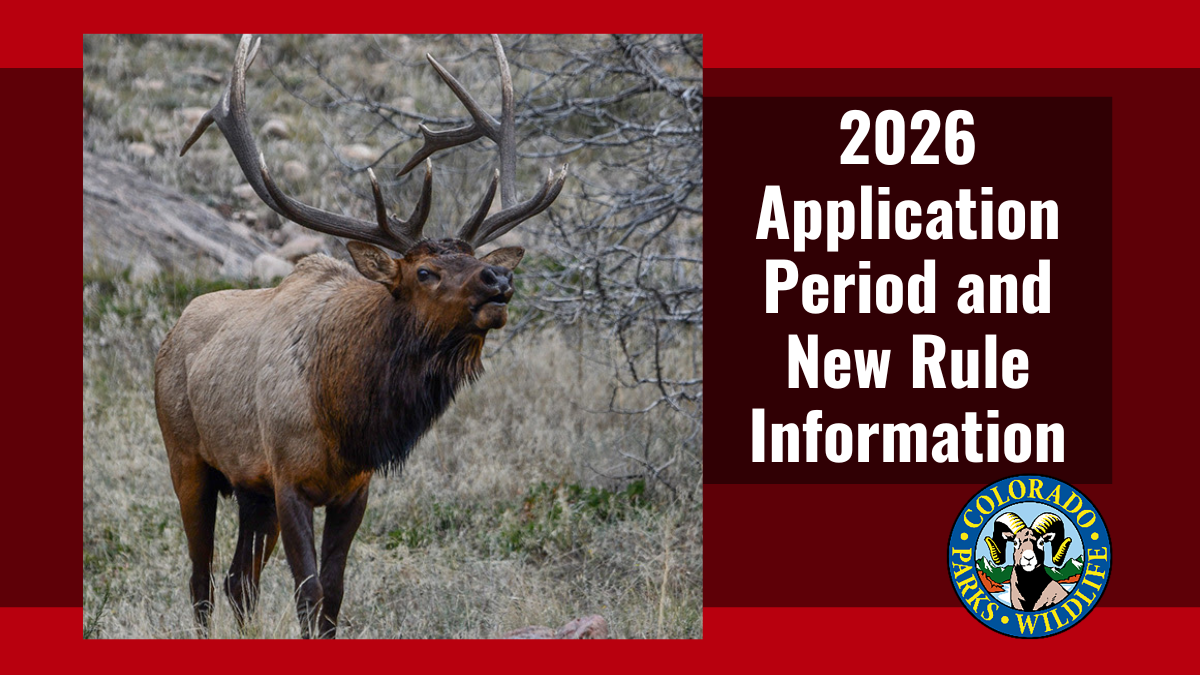
Application period for Colorado big-game licenses begins March 1
DENVER — It is time for hunters to start planning their 2026 Colorado adventure. Hunters hoping to draw a big-game license in 2026 are urged to review the changes in licenses, seasons and fees in the 2026 Colorado Big Game brochure prior to the March 1 opening of the primary draw application period (March 1 – April 7 at 8 p.m. MT).
Four Corners SCI is not responsible for links that take you to away from our website.
CPW encourages hunters to submit their applications early to avoid complications or delays. Get prepared ahead of time so that if problems arise, CPW staff members have ample time to assist you. View CPW’s hunting statistics for information from previous draws to help maximize your draw potential.
“The Colorado Big Game brochure is a must-have resource for planning a hunt and it’s available at all CPW office locations and online,” said CPW License, Reservations & Customer Operations Manager Danielle Isenhart. “We encourage all hunters to apply early and check their online accounts to ensure their contact information and credit card information is up to date and valid through May 2026. Hunters will receive email updates on their draw results and the status of their payments.”

Backcountry Search and Rescue surcharge increase
Hunters who buy a license also pay a $1.25 Colorado Backcountry Search and Rescue (BSAR) fee that funds local search-and-rescue teams and volunteers. While these organizations are county-based and coordinated through county sheriffs or county governments, CPW provides support and funding from the statewide level. Learn more about Backcountry Search and Rescue at cpw.state.co.us/BSAR.
Reminder: Nonresident archery elk licenses
Nonresidents can no longer buy over-the-counter archery elk licenses for GMUs west of I-25 and GMU 140. For limited hunt codes for nonresident archery elk west of I-25, see the hunt code table on page 43. These new limited nonresident archery elk licenses can be applied for in the draw. Nonresidents can still hunt over the counter in certain GMUs east of I-25 with hunt codes E-F-133-U1-A and E-E-087-U1-A. See maps on pages 38 – 39 for more details.
Reminder: Draw changes coming in 2028
The Parks and Wildlife Commission approved policy recommendations from the appointed Draw Process Working Group to reduce complexities within Colorado’s draw system and address preference point issues. The updated draw policy will go into effect in 2028. See the updated policy at: cpw.state.co.us/2028-draw.
Wild bison is now a big-game species
The CPW Commission approved regulations giving bison a dual classification as both livestock and wildlife, following the direction of the 2025 Protect Wild Bison Act (SB25-053). CPW regulations are designed to implement SB25-053. CPW is not proposing regular bison hunting seasons at this time. Under the new regulations, privately owned bison herds will continue to be managed as livestock. However, free-ranging bison that naturally enter the state from neighboring jurisdictions will now be managed as wildlife, specifically as a big-game species under CPW authority.
Mandatory testing for chronic wasting disease
In 2026, CPW will require mandatory submission of CWD test samples (heads) from all elk harvested during rifle seasons from specific hunt codes to better evaluate the prevalence of CWD in herds. There will be no mandatory CWD testing for harvested deer in the 2026 seasons. There will be no charge for mandatory testing. Not all hunt codes in a GMU were selected for mandatory CWD testing. Find the hunt codes selected for mandatory testing on pages 41–52 of the 2026 Big Game Brochure.
If a hunter is not selected for mandatory testing but wants to know whether their harvested deer or elk has CWD, they can submit their animal’s head and pay a testing fee of $25. Testing fees for voluntary submissions will be waived for all moose statewide and all elk from hunt codes that were not selected for mandatory testing but are within the same GMUs that were selected for mandatory testing (see list of GMUs on page 41 of the 2026 Big Game Brochure). Voluntary submissions are accepted annually statewide.
Gray wolves and coyotes: how to spot the differences
Be aware that gray wolves are now another one of the more than 960 wildlife species on the landscape in Colorado. Coyotes and gray wolves can look similar from a distance, so CPW created this handout to help you spot the differences. Wolves have been released both north and south of I-70, and we expect them to explore their new environment and travel widely. As our latest wolf activity map indicates, wolves are exploring portions of the San Luis Valley, so remember: Wolves can be present no matter where you may be hunting in Colorado.
The gray wolf in Colorado is protected by the federal Endangered Species Act (ESA) and state law.
State penalties for killing a gray wolf in Colorado
In Colorado, gray wolves are protected under state law. The state penalties for illegally killing a gray wolf can include:
- Civil penalties of at least $1,000
- Criminal fines of up to $100,000
- Imprisonment for up to one year
- Suspension of license privileges for up to life
Federal penalties for killing a gray wolf in Colorado
Gray wolves are federally protected under the ESA. The federal penalties for illegally killing a gray wolf can include:
- Civil penalties of up to $25,000
- Criminal fines of up to $50,000
- Imprisonment for up to one year
- Suspension or revocation of federal licenses or permits
- Anyone with information on the take of an endangered gray wolf in Colorado is encouraged to contact their local CPW office.
Plan your hunt
If you have questions about setting up accounts, planning hunts or applying for licenses, call center agents are available Monday – Friday from 8 a.m. – 5 p.m. MT at 303-297-1192. Hunting resources are available at: cpw.state.co.us/hunting/big-game.
Be sure to read the “What’s New” pages in the 2026 Big Game brochure and the sheep and goat brochure to get a full list of game management unit specific changes for 2026.
*Note to hunters: CPW harvest data from 2025-2026 will not be available until mid-March. License quotas for deer, elk, bear, pronghorn and moose will not be finalized until the May 2026 Commission meeting after staff are finished analyzing data from population surveys.
SCI Sables are committed to furthering the understanding of our outdoor heritage, including the positive role of hunting, through the creation and support of wildlife and conservation educational programs. CLICK TO LEARN MORE


