
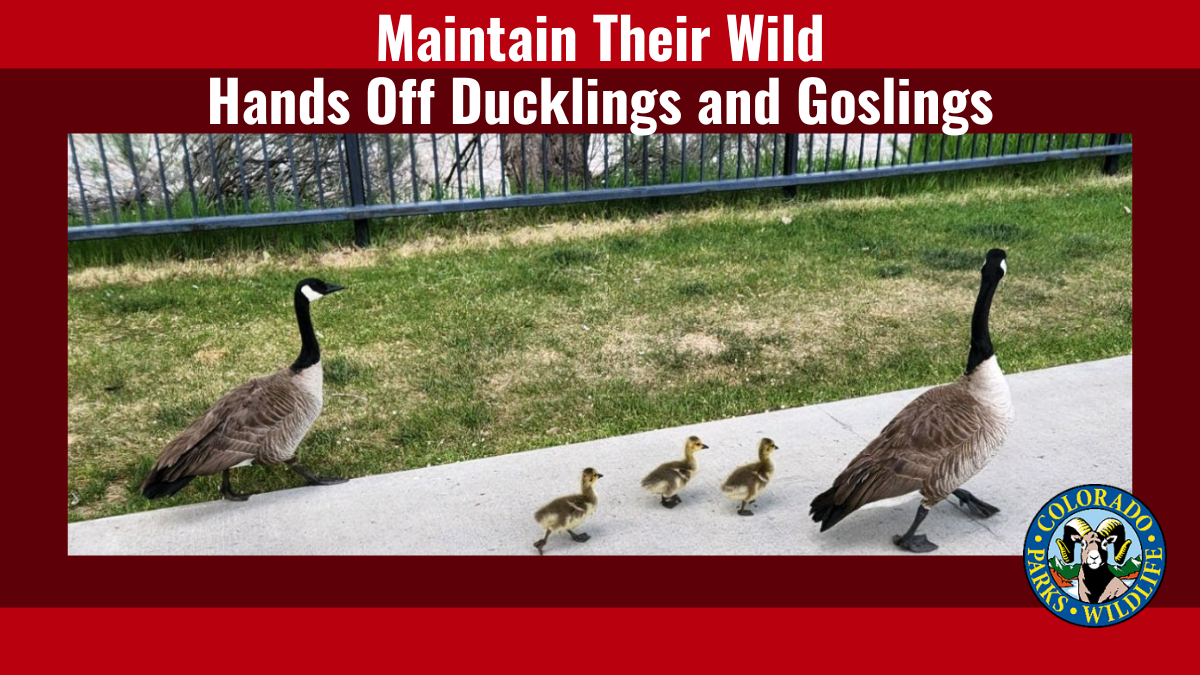
Hands Off Ducklings and Goslings to Maintain Their Wildness
DURANGO, Colo. – Ducklings and goslings are starting to appear along bodies of water all across Colorado. It is crucial for their development that humans leave them alone and never pick them up.
Young birds will begin to imprint on their mothers shortly after hatching. Learning to follow them provides safety and is critical for their long-term survival.

Ducklings and goslings can quickly imprint on humans, and Colorado Parks and Wildlife asks the public to never pick up these young birds.
“The best moms are their moms,” said CPW District Wildlife Manager Stephanie Taylor. “They are quick to imprint, and we also don’t want them to lose their natural wariness of humans.”
Each year, CPW takes calls from people who have picked up a young duck or goose, and Durango area wildlife officers have already taken such calls and observed people getting too close to nests and goslings this spring.
Four Corners SCI is not responsible for links that take you to away from our website.
If a duckling or gosling imprints on a human, it will not be able to survive in the wild. It is critical these young birds are given space and are not interfered with. Even a brief human disturbance can have consequences and can lead to a young animal being separated from its family.
If you find young wildlife, enjoy a quick glimpse, leave the animal where it is and keep pets out of the area. Quietly observe the animal from a distance and don’t hover so close that the wild parents are afraid to return to the area.
“We know people often want to try to help young wildlife,” Taylor said. “The best help is to leave the animal alone if it’s not in danger. If the gosling or duckling is in danger, for example in the road, then quickly move the animal off to the side of the road. This has minimal human-wildlife interaction, and the parents are usually nearby waiting to reunite with them.”For more information on best practices with young wildlife, go to CPW’s Spring Wildlife Advice page.
CPW is an enterprise agency, relying primarily on license sales, state parks fees and registration fees to support its operations, including: 43 state parks and more than 350 wildlife areas covering approximately 900,000 acres, management of fishing and hunting, wildlife watching, camping, motorized and non-motorized trails, boating and outdoor education. CPW’s work contributes approximately $6 billion in total economic impact annually throughout Colorado.

